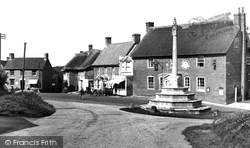
Memories of Child Okeford
Get involved in the Frith Memories Community - savour and share Memories of your favourite places.
You can start now: Add your own Memory of Child Okeford
or a Child Okeford photo.
I lived and worked at the manor from Sept 1986 to around May 1988, if anyone remembers me and wants to get in touch please email. j.goodwin007@hotmail.co.uk
Shared on 11 November 2009
Evacuation to Hanford House in war time
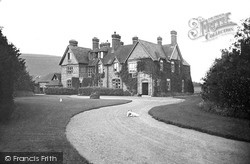
My sister and I came to Hanford House with the Wimbledon High School at the beginning of the war. After a year the school returned and the owner of the house, Mrs. Lister, collected a small group of teachers and offered to keep on any children whose parents did not want their children in London. We stayed two further years during which time as well as receiving a surprisingly good education we enjoyed the country life, riding, walking and helping in the gardens. One term another school, Eversley, was billeted on us and several of us had to stay with people outside. It was quite a difficult period as they felt very superior to us, so we were glad when they left. One afternoon a friend and I were hiding in a garden shed during a game when two planes went overhead one English and one German and there was a lot of shooting. We were soon called in and had to take shelter in the cellars. We were very lucky to have wartime rations supplemented by fruit and vegetables from the garden and rabbits shot by Colonel Lister on the estate. Like many young girls we were mad on horses and the school provided us with the opportunity to learn to ride and care for the horses and tackle.
During the time we were there Mrs. Lister's grandson and granddaughter came to stay at the school, Julian and Edwina Sandys and Julian caused quite a stir in the local Post Office when, on seeing a poster of Churchill, he announced "There's Granpa."
Shared on 23 April 2008
I remember these fields before any building was done in this part of the village.
The fields were owned by Mr Fred Bradley and Mr Harry Watts. I can remember going with Mr Watts to see if any cows had calved in the night. At the top of the field there was a large pond that in spring would be full of frog spawn.
Mr Bradley would keep his cows in these fields at night to be close for morning milking, but by day they would go to the very bottom of Melway Lane, about 2 miles from his farm. When I was about five Harriet White used to come and collect me from my home at the shop to go with her to collect them for afternoon milking.
Shared on 22 February 2008
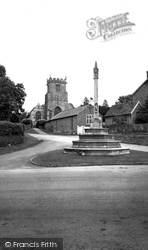
This photo brings back all sorts of memories! The house nearest the camara was the home of Mr Cottle the village harness maker, the double doors next to it led to the butchers yard, in those days they used to kill the animals behind the shop. The butcher was Mr Turner. He was followed by Mr Dyer whose son had the shop till it closed down in 2001?
Beyond the pub and not in the photo lived farmer Mr Francis who had a milk round and after the war Mrs Francis started making ice cream, the first those of us born since 1940 had seen.
It was here that after we moved on to "Big school" we used to wait for the school buses.
Shared on 22 February 2008
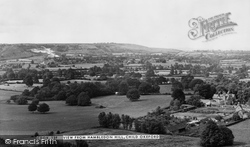
Hambledon Hill played a great part in the first 15 years of my life as it did for most children of the village.
My very first memory is the huge bonfire built on top of the hill to mark the end of WW2, both my Father (Guy Moon) and George Diffy from the Post Office found some fireworks, this was the first time I had seen fireworks.
While at the village school we used to be taken on nature walks on the hill and used to go into the Yew wood at the Hanford end of the hill.
We were also taken to see the pre-historic pits left on the hill from the huts that must have been there, we found many flint tools which we used to carry back to school.
Much of the holidays were spent on the hill also, we used to take tin trays up to slide down into the dips, or in winter proper sledges.
I also used to go rabbiting on the hill with Mr Walt Wareham who seemed to make a living from it.
It is only in recent times that any crops were grown up there, in my youth it was all grass or scrub.
Shared on 22 February 2008
HANFORD HOUSE
In the early years of the war, I taught at the school which was part of Hanford House. The rest of the house was occupied by a family I remember as the Listers (Colonel and Mrs.). My son-in-law, however, thinks it might have been Captain and Mrs. Sandys, the parents of Duncan Sandys. Mr. Sandys was, of course, later a cabinet minister in Harold Macmillan’s government, and later still, became Lord Duncan-Sandys.
Duncan Sandys and his family certainly came to stay, and also lived at Hanford House for some time. As a consequence of the illness of their children’s nanny (Grace), I was asked to help with the children, especially, Julian, then about 4, who later became a barrister, and died in 1997.
I used to read to him and his sister, Edwina, and I particularly remember being asked to sing Julian The Skye Boat Song (‘Speed bonny boat, like a bird on the wing’). I also remember him saying to me ‘My grandpappa smokes a big cigar!’. His ‘grandpappa’ was, of course, Winston Churchill, and his mother was Diana, Winston’s daughter, who led a rather tragic life, and died of barbiturate poisoning in her fifties.
I also remember a girl called Katie, who I think was fostered by the ‘Listers’. I taught her to swim, but sadly she also died young, of pneumonia, at her boarding school in Yorkshire.
I remember Mrs.Riddle, the cook-housekeeper, who made valiant efforts to feed us, despite war shortages.
The house was very impressive: I remember the oak panelling on the walls, and a carved rose on the staircase which was a disguised door handle, which if turned, would reveal secret passages used, we were told, in the Civil War. The grounds seemed to me huge, though few staff were employed probably due to wartime restrictions.
If anyone can add to, or comment on these memories, please get in touch through my son-in-law at martin.johnson@virgin.net
Jean Barsley (formerly Vickers)
Shared on 02 February 2008
During the early 1960s my Aunt Bella and Uncle Alf lived down Ridway lane in a bungerlow called Fernleigh. It was detached, I suspect that it was part of field as the property had a five bar farm gate. Looking out of the bedroom window you could see the cows in the next field trying eat my uncles apples. He love his garden. There were a number of apples it would not surprise me if part of the property was an orchard. My family and I stayed with them. Travelling by train and arriving @ Shillingstone Station. I always had great excitement crossing the line (we changed @ Temple Coombe). Coming from Harrow in Middlesex it something never done. My mother remembers the oil lamps on the station. My Aunt always arranged for us to be picked up by taxi from the Stone's(I remember playing with their boys) garage. The Tuffins lived @ the farm @ the top of Ridgeway Lane. I remember having great fun with daughter Claire playing in their hay stack. A little way beyond my aunt lived the Footes, more children there 2 girls one I think had the name of Elizabeth. More play mates! A vivid picture I still have is of the cows being taken down the lane to be milked. Twice a week there was a journey to Stir or Blanford on bus which we hailed on the main road @ the top of the lane. Before waiting for the bus we would have to change from our wellies ( which we threw in the hedge) for shoes so we did not mess up the bus. Another new experience for me was going to the baker to buy the bread in the bakery not a shop. Christine Amerstone took me to choir practise in the week and I was given the previlage of being part of the chior on a Sunday. I loved the robes, back @ home I went to a Baptist church with not a robe in sight. I can still see the lovely stained glass window behind the alter and also have a vision of me standing on a kneeler to see over the top of chior stall! I was really small. Harry Corbett(of Sooty & Sweep fame) lived in the village, but I never saw him. Somewhere @ the top of the village before the High Street live a lady with a boxer called Bruce, the garden had a stream with a bridge over it. I remember playing in the park, well from what I can remeber there was some swings and a climing frame. Sunday papers were collected @ a house. One of the shops was called Moons, I presume that was the people who owned the shop. As to what they sold I cannot remember. The smell of fresh bread was wonderful when my aunt took me to buy bread in the bakery not in a shop. Sunday papers were brought from a house in the High Street, not a shop. Somewhere between Ridway Lane & the High Street was something called Jacobs Ladder, though that is more vague. Although I remember all these sights and smells I was too young to really appreciate them.
Shared on 28 November 2007
I remember the village in the 1940s to 1970s.
I went to school at the centre of the village till 1951 then went to Sturminster S.M school. On the walk home from school we used to go into the forge run by Alfred Wolfery (known as Bogey as he was as dirty and sooty as the bogey man!)
Across the road from the forge and Post office was Mr Fox's bakery. He would give us wonderful hot bread and iced buns. Just on down the road was Mr Hutchins the local wheelwright and undertaker, he also had a cow which he used to take out on a halter to eat from the hedges. A few more yards down on the right was Mr Fred Bradley's farm, most of the work was done by Harriet (White) who spent most of her time moving cows from farm to fields a long way from the milking sheds.
When I started school the teachers were Mrs Laurence in the infants class and Mrs Jackson in the "big" class.
Mr Pride ran the Bakers Arms and Sid Adams the Union Arms pubs and Mrs Hart ran an off licence at Goldhill.
Mr Diffey had the Post office , we also had a Co-op, a butcher Mr Turner, and a shoe repairer Mr Hart, my father had the third shop in the village at that time.
As kids we spent most of the summer holidays either up on the hill or in Okeford coppice where we made dens and would dam the stream to make paddling pools.
They were very happy days and gave us a good start in life, and as everybody knew who we were, we were fairly well behaved.
David Moon
Shared on 02 September 2007
Once an idyllic Dorset village.
Since about the 1960s, Child Okeford became a totally different community from the one I first got to know in the early 1930's. The Watts (Harry and Dorothy) had farmed out of Laurel Farm for many decades and Jo(sephine), the daughter, was my cousin by marriage.
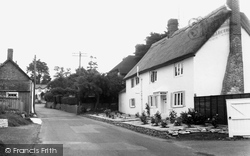
Laurel Farm, as it is today in the late 1900s, is shown to the left of this memory. Sadly, the main characteristics - with the exception of the thatched roof - have gone. Also gone, are the numerous attached and detached buildings and facilities, which made the place a farmhouse.
I stayed at the farm on many occasions, during the 1930s and 1940s. As I grew so did my various responsibilities on the farm - but I must say the 'unskilled' labours were my forte - I had few real farming skills. Nevertheless, my broad back and great willingness to work were a welcome addition to the everyday workforce. In particular, these physical attributes were much in use during harvesting. I could use a pitch-fork and a rake as well as almost anyone!
The farm was normally worked by Harry and Jo, with Reg a hard working farmhand. Horses were much used - indeed, in the early 30s I was met at Shillingstone Station by Jo in the milk-float - always with Loo the Welsh Collie. Loo worked, herding the 'loose' cattle - mainly at milking time but, also, if they had to be moved. In those days, cattle were a constant sight on the roads and Reg often took the bull for a stroll as exercise. A stout pole hooked to the animal's nose-ring provided a degree of security. All milking was done by hand and the Home Farm herd ambled up to the farmyard to await admission to the milking shed which ran alongside Shillingstone Lane to the south of the farmhouse. The northerly end of this shed was utilized as stabling for the horses. At the southerly end of the milking shed, was a covered platform on which the milk churns were kept. The full ones were picked up by a dairy lorry each morning - and clean churns left. Of interest is the fact that, in the warmer weather, the evening milk was kept in churns, in a suitably constructed roofed 'cooler' in a small stream down the adjacent lane - now called Melway Lane.
The farm, was mixed. Cattle, pigs, horses, chicken were tended - along with turkeys, geese, ducks at various times. Fodder for the animals was grown along with corn (usually wheat) and, its indispensable by-product, straw for the bedding - and other sundry uses. Opposite the farmhouse, across the road, was a large orchard. Besides the fruit, this orchard was used for the various poultry. Carrying water to these, and the other creatures, was almost a full time occupation - especially in the summer months. To the east of the farm buildings and garden, was another large orchard also used for animals and poultry.
The farmhouse was without indoor plumbing. The primative lavatory was up the garden - some 100 feet from the house. Pumps gave access to an underground spring which produced water of nectar quality. However, the kitchen was the only place hooked into this water supply. Downstairs was a delightful parlour, a large kitchen/dining room (which is largely remembered for the huge table which groaned under the weight of food placed upon it - three times a day!), a scullery (dominated by a huge old fashioned clothes wringer - called a mangle) and a buttery where butter was churned, cream made, cider stored and everyday 'perishables' were kept. A small room off the scullery was the gun-room - and clothes storage. Upstairs, up the very steep narrow staircase, were four bedrooms. Due to the home's construction and in particular the thick thatch, the windows let in relatively little light. Sadly missing, from the property today, is the thick laurel hedge. This wonderful hedge once gave complete privacy to the house occupants, even though the street was mere feet away. The absence of this hedge, is noted with great sadness.
Water troughs were placed strategically in the farmyard, for animals and general use, while the cattle were grazed in fields bordering the Stour river at Shillingstone. Some 20 head were milked in the open fields, night and morning, by hand. Morning milking was done, first in the open fields and then up in the milking sheds at the farm, starting about 6am - and before breakfast! As a youngster, I helped keep the milk churns 'available' and cleaned out the flies that always littered the milk-strainer. Although Shillingstone was not a busy station, I always enjoyed the sight of the occasional train, as it arrived and exited the station across the river.
Moon's store, at the top of the road, was a favourite place of mine. Moon's was a General Store, but mainly groceries and confectionery. Here, for half an old penny, I could buy 'Orange Balls' - a small round hard candy sweet - sufficient with care to last a couple of days. Cadbury's 2oz chocolate bars were tuppence each. Seldom, on my pocket money, could I afford chocolate! Diffey's was more central in the village and, beside being another General Store, it was the Post Office and local Telegraph Office. Few people had telephones, in the days of which I speak, so telegrams were very much in vogue for transmitting urgent messages. The village smithy worked at his forge, just at the back of Diffey's store.
A search of a turn of the century ' Kelly's Directory' shows that, outside
the 17 'Gentry' (Vicar, J.P.s, Doctors etc.), there are listed 44 people engaged in 'Commerce' within the village. There were 9 people farming, 13 shop/store keepers, 2 innkeepers and a beer salesman, sundry farm equipment makers or repairers, boot and shoe makers, 4 bakers, a tailor, a carrier, a music teacher (church organist), a saddler, 2 plumbers and a painter.
It was, truly, an idyllic Dorset village!
Shared on 27 August 2007
In about 1967 my mother and father moved to this lodge after selling the Corner Store in Child Okeford. It belonged to Hanford School. It was sad to return a few years ago to find it had burned to the ground.
Opposite was one of many tracks leading to Hambledon Hill, my Father used it most days to walk his dog Gladys, if he could not go she took herself!
About half a mile further along the road to Steepleton corner on the left, are the remains of the ice house belonging to Hanford House. As children we used to use it to play in.
Shared on 13 March 2007
My then husband Derek Schwier and I bought Laurel Farm in 1963 from Jo Watts - a wonderful jolly character in her dung-coloured dungerees and mucky boots! All her cows were lovingly tended, and her retirement was a sad loss to the farm.
But it was our gain and for personal reasons we re-named it "Pilgrims". Our children had great fun playing in the orchard - now built on - and having their first ponies.
But the most vivid memory of Child Okeford for me is the Union Arms just opposite, with the indefatigable Bea Lovell and her "Parlour, where a large table and odd chairs was the "bar" and a dresser held the jugs of ale and cider with china tankards for her "regulars" all different designs and sizes.
With the old Collie "Laddie" by her side, she welcomed everyone and for her age - she was reputed to be over eighty - she ran her pub with energy and ethusiasm. Our children loved going to see her, and usually came back with a sweet or biscuit - and one visit, even a cider mug each.
When she died, it was a sad day for many of us, but it is a memory that I hope others will remember with affection.
Shared on 26 September 2006
The house on the right was formerly known as Laurel Farm, but the name was changed by my father in the 1960s to Pilgrim's Farm, as this was the name of his business in the village. The house was rethatched during our time there; there was a housemartin's nest under my bedroom eave (the window furthest away, top left of the house) and the thatcher worked around it and came back to finish the roof when the birds had hatched and left, so they would not be disturbed. My father sold the house to Harry Corbett of 'Sooty and Sweep' fame, and he lived there for many years. On the right of the crossroads further up was a village shop which in my childhood was run by the delightfully-named Mr Moon and his wife.
Shared on 06 September 2006
Need to revise your search? Click here for our Search Homepage, where you can browse by Place, Postcode or Keyword.