Bristol
Bristol photos
Displaying the first of 201 old photos of Bristol. View all Bristol photos
Bristol maps
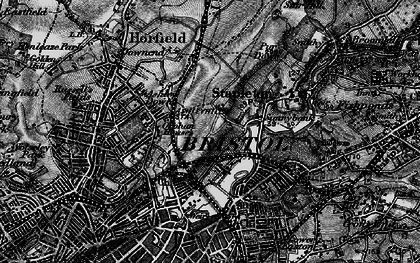
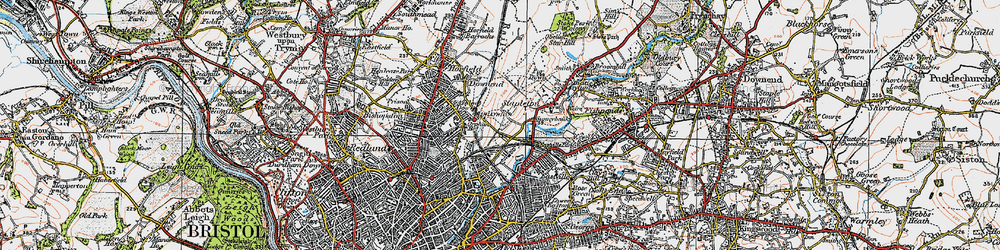
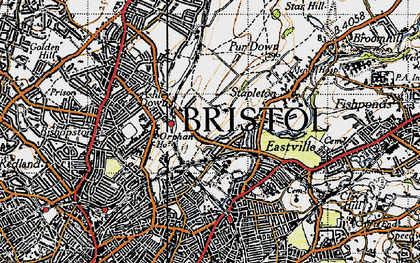
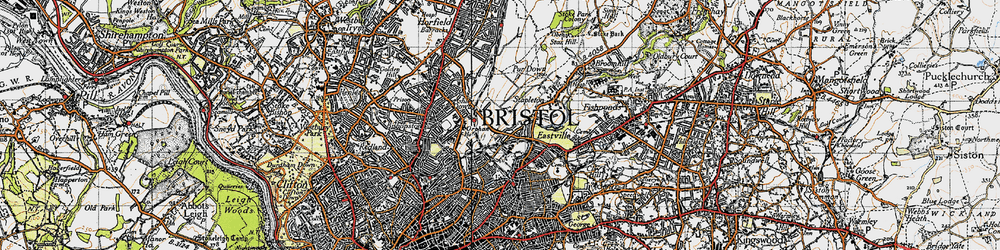
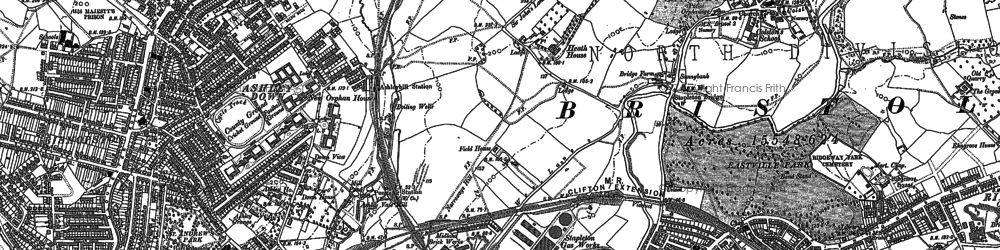
Historic maps of Bristol and the local area, hand-drawn by Ordnance Survey and Samuel Lewis. View all Bristol maps
Bristol area books
Displaying 1 of 6 books about Bristol and the local area. View all books for this area
You can read extracts and browse photos from these books.
Memories of Bristol
Displaying a selection of personal
memories of Bristol.
There are 65 shared memories to read.
Add your memory of Bristol
or of a photo of Bristol.
Bristol City Docks 1989
Two of the cranes were purchased by 'City Dock Ventures' and two by the city council. All four were put into the museums care in 1989. Although the electricity supply to them was cut in 1974, one has been restored and another is in the process of being restored by a dedicated team of volunteers, led by Dave 'The Crane' Cole. One crane is now fully working and sometimes open for the public to go up to the cab and see it in action. It has also been used for TV programmes and plays. They remain the only partially or fully working old city dockside cranes in the country. Often the driver couldn't see where he was lowering the cargo to so he completely relied on a banksman (on the shore) or a hatchman (on the ship) to relay how to manoeuvre with hand signals. The drivers had to obey the signals. Although there were set signals, every banksman would do them slightly differently and some in a very subtle manner,... Read more
Bristol's Leaning Tower of Temple
Pisa has its famous leaning tower - and so does Bristol, with its drunkenly off-vertical tower of Temple Church in Temple Street. The tower isn't on the stupendous scale of its Italian counterpart, it's true. But its prominent position by busy Victoria Street and its proximity to Temple Meads station make it one of the most startling sights to be seen by newly-arrived visitors to Bristol. Poor old Temple Church was badly blitzed during the air raids of the Second World War and the building remains a gutted ruin half a century later. But it wasn't enemy bombs which caused the tower to reel over five foot out of true. That happened after it was rebuilt in 1460. The foundations caused problems which couldn't be solved, the tower began to move but, at last, it settled at today's offbeat angle. There has been a church on this site since 1145 when the mysterious order of Knights Templar erected their chapel here - nearby Temple Meads takes its name from the order.
Christmas Steps Bristol BS1
Goddamn fish and chips! At the very bottom of the Christmas Steps lies a building thought to date back to the 13th century, which has housed a fish and chip shop for well over 100 years. One of the first ever 'chippies' to open in England, this shop won a Best in Britain award whilst under the management of the inimitable Grace and Robert. After taking over the restaurant in 1964, the couple remained there for the next 28 years. Grace has entertaining stories to tell about American tourists determined to lay their hands on some genuine 'goddamn fish and chips'. She recalls embellishing the truth on some occasions, leading Americans to believe she had a bed upstairs upon which Queen Anne herself had slept (which is not completely accurate!). The tourists' fascination with antiques and memorabilia would often prompt them to make Grace an offer on anything which could be removed from the premises. She also has fond memories of the street parties that have been held on Christmas Steps,... Read more
Privateers And Pirates
The Llandoger Trow - It is rumoured that Daniel DeFoe had met Alexander Selkirk ( shipwrekced sailor who had been rescued by a Bristol ship) in the Llandoger, on whose story he based his book 'Robinson Crusoe'. The Llandoger is also supposed to be the model for The Admiral Benbow pub in Robert Louis Stevenson's classic adventure book 'Treasure Island'. Blackbeard the pirate, who also came from Bristol, may even have drank at The Llandoger. However none of this can be proven. Although the pub now has 3 cellars there may have been more than this with a network of underground tunnels, the remains of one was found in 1962 when the pub was refurbed but sadly destroyed and steel piling had to be sunk 43ft down into the marsh to hold it up. During that refurbishment, 7 original fireplaces were also uncovered. There are also documents in the pub about a previous landlady who blacked out the 'busty ladies adorning the pubs ceilings' who she felt took the attention of... Read more
The Tomb of Raja Ram Mohun Roy
Arnos Vale Cemetery is the location of the tomb of Raja Ram Mohun Roy - 'The Father of Modern India'. He died when on a visit to Bristol in 1833. This gentleman left home and 'sought knowledge by his extensive travels'. He mastered ten languages, encouraged the study of English in early 19th century India and was a journalistic pioneer in India. He came to England in 1830 to plead the cause of the Mughal Emperor Akbar II (who gave him the title of Raja), died three years later and was buried in Arnos Vale Cemetery in Bristol. A large monument was erected above his remains in 1842 and this is now in perilous state. It is estimated that 25,000 will be needed to restore it and The Bristol General Cemetery Company, which has taken over the cemetery, will not carry out the work because no money was left for its upkeep. As this is the 50th anniversary year since India's Independence, it is suggested that it could be financed... Read more
Bristol at Sea
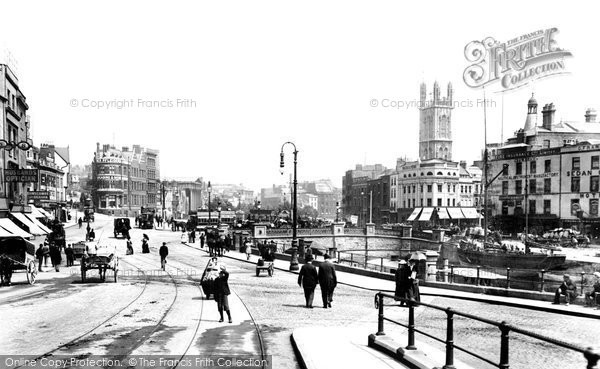
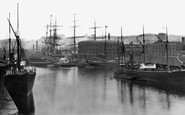
Over a thousand years ago Bristol's harbour developed around the lowest bridging point of the River Avon. The exceptional tidal range of the Severn Estuary and Avon carried laden ships into the city and scoured the river of silt. Local trade flourished between Bristol, South Wales, the Severn ports and Ireland. During the Middle ages the port grew in prestige, trading with the Atlantic seaboard, Iceland and the Mediterranean. The American colonies brought more opportunities for Bristol merchants including the notorious slave trade to the West Indies. As ships became larger and trade increased the quay space became overcrowded and when the water drained away at low tide the ships lay grounded in the mud. Finally the Bristol Docks Company adopted the proposals of engineer William Jessop to create a non-tidal harbour. The 'Floating Harbour', constructed between 1804 and 1809, trapped the water behind lock gates allowing ships to remain floating at all times.
A Long Street, Full of Ships
Having a harbour right in the city centre gave Bristol an unrivalled attraction for visitors who gazed in wonder at the sight of tall masts - 'In the middle of the street, as far as you can see, hundreds of ships, their masts as thick as they can stand by one another, which is the oddest and most surprising sight imaginable', wrote Alexander Pope in 1732. A long street, full of ships in the middle and houses on both sides, looks like a dream. It's a dream that no one will ever see again. Picturesque it may have been but the ships got in the way of the traffic.
Dutch House
The Dutch House - this 17th century building once stood on the corner of Wine Street. It was reduced to a charred skeleton during the Second World War and for safety's sake it had to be pulled down. The Dutch House was Bristol's best-known landmark before the Blitz. By 1732 it was the house of John Vaughan, a goldsmith, in 1810 it became the Castle Bank, in 1826 the Stuckey's Bank; and by 1855 it was occupied by Mr Tilly the Hatter (he first called it Dutch House though it has no connection with Holland). In 1908 it was saved from demolition by the Lord Mayor's casting vote. During the 1930s it housed the Irish Linen and Hosiery Association but was pulled down after being seriously bombed in 1940.