CHILDHOOD MEMORIES 1939-1945.
1 comment has been shared below in response to "CHILDHOOD MEMORIES 1939-1945."
Get involved and post your comments using the comment form below.
Year: 1940s
CHILDHOOD MEMORIES 1939-1945.
My Dad, Sid Brooks was the rural village police constable (P.c.200) for Cropwell Butler, Cropwell Bishop and Tythby We, Mum (Dorothy) and my younger brother Mick lived in the Police House on Radcliffe Road, There was an old fashioned stem type phone connected to the manual exchange. Dad’s means of transport for work was a sit up and beg style Raleigh pedal cycle. See also 'Police House 1939-1946).
In the centre of the village, behind the green the kids spent many hours watching Mr Harrison at work,in his forge making horse shoes or wrought iron items and shoeing horses.
Nearby was Cheetham’s Bakery, Cheetham who delivered bread with a horse and covered wagon. On Hardigate Lane was Branston’s Bakery who delivered bread in a van. I loved being asked to collect our bread which usually arrived home minus the delicious crust. Milk was delivered daily by Cockaynes using a horse and cart. Milk was dispensed from pails into jugs. A grocer, Mr White, from Radcliffe or Bingham used to come on a Monday and take Mum’s order, for delivery on Friday.
The Rev. Lees conducted services at the C of E church which had a hand pumped pipe organ.. Nearby was a small shop (Parnham’s) and a Post Office. Lewis’s Bus Service ran a few trips a day from Cropwell Bishop via Hardigate Lane, Cropwell Butler and Radcliffe to Nottingham Starbuck’s from Cropwell Bishop ran on market days Wednesday and Saturday. along Radcliffe Road, to Nottingham. Every Friday Barlow the butcher from Cropwell Bishop called in his van.
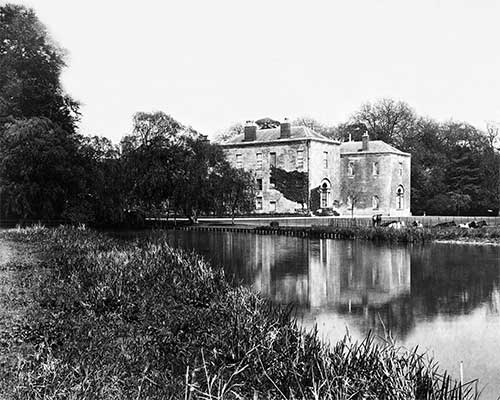
There were some large houses in the village owned by the Green’s, Hawthorne’s and the largest, opposite the White House was belonged to Mr Radford who owned Griffin and Spalding, now Debenhams.. He was often seen in tweeds, a cap and plus fours walking in the village.
The village mixed school had 3 classrooms for ages 5 to 11 with 3 teachers Miss Starbuck, Miss Roworth and Miss Cuthbert, the headmistress. I started school in 1941 aged 5. World War 2 was in progress of course and we had to carry gas masks in a box with the strap over our shoulders. School windows were covered with a stuck on white mesh material. . .
Each teacher taught two age groups in each of the three classes talking to one half whilst the other got on with written exercises. Miss Cuthbert used to punish kids by hard slaps on the backs of the hand or in extreme cases, for older kids, with a strap across the buttocks.
School dinners were provided for 2/- per week. We also received free bottle of 1/3 of pint of milk a day to ensure kids received enough calcium, etc a day to prevent rickets. One village boy wore leg braces due to rickets. On fine Wednesday afternoons we attended to the school garden used for growing vegetables. Wwe were being urged to “Dig for Victory”.
The local area had about 26 RAF bomber, fighter and training stations and aircraft of all types were a common site.
Nottingham or a local RAF Station would be the target of a German bombing raid and sirens would signal the start of an air raid. We often heard the distinctive sound of German engines overhead and after the all clear siren a bright glow could be seen coming from the direction of Nottingham. We could also see searchlights and anti aircraft fire One night, the sound of German twin engines was followed by an extremely loud bang. A high explosive bomb hit Parkin’s farm about half a mile away in the village, killing Mrs Parkin. . On one occasion three incendiary bombs were dropped on our vegetable garden about 10 metres from the rear of the house. After that Dad often boasted about growing roast potatoes.
Prior to D-Day there would be heavy traffic on the Fosse and planes, D,C, 3’s or bombers towing gliders dropping hundreds of parachutists beyondr Hoe Hill In the field opposite some soldiers came one day and began digging trenches and practiced with mortars and flares. The kids would get up a little earlier to collect the small silk parachutes attached to the used flares. They were popular trophies or playthings at school.
At harvest time we loved watching the steam traction engine threshing the wheat.. Similarly, when a road had to be resurfaced by means of tar and stones, we used to watch the steam roller in action.
Often truck loads of guarded Italian prisoners of war were driven to farms to do the labouring work.
We had never tasted oranges or bananas and many other essentials and luxuries were denied us by the rationing. To compensate Mums gave children a spoonful of thick malt and molasses concoctions plus Halibut or Cod Liver Oil .
During the war Britain was on ‘Double Summer Time”, that is 2 hours daylight saving, supposedly to help the farmers. In June it was daylight until about midnight, making it very difficult for parents to get their kids to sleep.
Mum was Secretary of the Women’s Institute. Dad, with Mum’s help used to organise dances and film shows at the local Village Hall to raise money for local charities and for a social activity. Waste paper and scrap metal drives were often held in aid of the war effort.
Mum and Dad' friends included Ron and Marjorie Wells who lived at the “White House”, Edith and Cliff Dawson, Cattle Removers who had a farm off the Fosse Road..Mum was very friendly with Vera MacIntosh, later Mrs Ron Branston..
On hot summer days we occasionally had picnics and a bathe by the Grantham Canal. We tried fishing on a few occasions with a line and bent pin but without success. We did however catch tadpoles with a net occasionally.
I enjoyed life in the village but In 1946 Dad was promoted to Sergeant and we moved to Mansfield Woodhouse.
peterb6136@hotmail.com
Shared on 18 January 2008
Comments
Year: 1947
RE: CHILDHOOD MEMORIES 1939-1945.
I have been trying to get proof that a school actually existed in Cropwell Butler so as to persuade the people who run "Friends United" would include it in their list. This is the first actual reference I have seen that mentions such a school.
I went there from around January 1947 to about 1950 when my family moved to Cotgrave. But my brother and sisters attended at the period covered by your earlier informant, perhaps he would remember the Williamson family from Tythby ?. John, Mary, Joan Flo.
The teachers were the same whilst I was there and I rember Miss Rowarth, now living at Langar I believe, and Miss Cuthbert well.
I differ in one memory as my brother John went there until he was 14 years old, the then leaving age, as did all those who did not pass the 11 plus exam.
I do remeber the Victory in Europe day, I was perhaps 4 years old at the time, a village party being held at "Little Cropwell" including us from Tythby. I remember Mr. Lees the vicar, and Mr Evans who replaced him. I have photographs of him when Field Marshall Montgomery visited Tythby Church. At the time being a guest of Sir Miles Graham who was one of Monty´s assistants during WW2.
I remember the names of many of the pupils at Cropwell Butler School.
I have two sisters still living in the area who´s memories are much better than mine, one at Cropwell Bishop, never having moved much further away.
I too used to go to watch horses being shod by Mr. Harrison, my Dad used to take some of them.
They were good years and Tythby and Cropwell Butler were good places to grow up in. Brian Williamson
Shared on 02 August 2008