Places
36 places found.
Those places high-lighted have photos. All locations may have maps, books and memories.
- Pentre-cwrt, Dyfed
- Pentre Halkyn, Clwyd
- Pentre, Mid Glamorgan
- Ton Pentre, Mid Glamorgan
- Pentre, Powys (near Llangynog)
- Pentre, Powys (near Guilsfield)
- Pentre, Powys (near Bishop's Castle)
- Pentre, Dyfed (near Pontyates)
- Pentre, Powys (near Newtown)
- Pentre, Clwyd (near Mold)
- Pentre, Clwyd (near Ruabon)
- Pentre, Shropshire (near Chirk)
- Pentre, Clwyd (near Hawarden)
- Pentre, Clwyd (near Chirk)
- Pentre, Clwyd (near Ruthin)
- Pentre, Clwyd (near Mold)
- Pentre, Shropshire (near Oswestry)
- Pentre, Powys (near Welshpool)
- Pentre, Clwyd (near Mold)
- Pentre, Shropshire (near Forton)
- Pentre Broughton, Clwyd
- Pentre Gwynfryn, Gwynedd
- Pentre Maelor, Clwyd
- Pentre-clawdd, Shropshire
- Pentre Galar, Dyfed
- Pentre Llifior, Powys
- Pentre-cefn, Shropshire
- Pentre-Gwenlais, Dyfed
- Pentre-Poeth, Dyfed
- Burntwood Pentre, Clwyd
- Pentre Berw, Gwynedd
- Pentre Hodre, Shropshire
- Pentre Llanrhaeadr, Clwyd
- Pentre-celyn, Clwyd
- Pentre Cilgwyn, Clwyd
- Pentre Morgan, Dyfed
Photos
98 photos found. Showing results 2,561 to 98.
Maps
316 maps found.
Books
2 books found. Showing results 3,073 to 2.
Memories
1,253 memories found. Showing results 1,253 to 1,253.
Captions
3,593 captions found. Showing results 3,073 to 3,096.

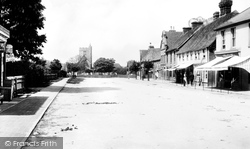
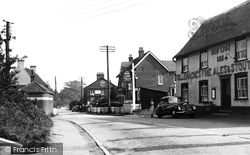
During the 15th century, Headcorn was a cloth-making centre which prospered with the arrival of Flemish weavers, and its single, long street has several fine buildings dating back to that time.
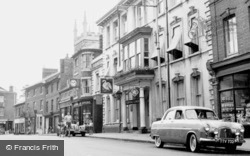
The parish church is just south of the High Street - we can see its tower (centre left).
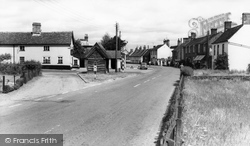
The white gable (centre right) is the former Swan, closed in the 1930s. The adjacent village shop closed in 2001.
The Post Office and Stores (centre) run by C J Brook closed in 2002. On the left, the rounded brick building is now part of Hollingsworth's butcher's shop.
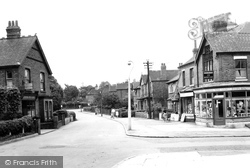
office has moved across the road into Read the tobacconist's next to the Gedling Wine Stores on the corner of Waverley Avenue – this shop is now Barber's Queue, a hairdresser's and sun bed tanning centre
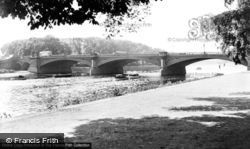
This view looks towards the 1871 cast iron Trent Bridge from the Victoria Embankment, a view much changed today, with the awful West Bridgford Hotel of 1962 (now Rushcliffe Civic Centre) replacing
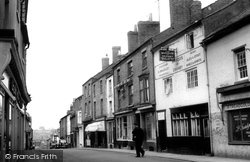
The Marquis of Granby was another one of the many pubs and alehouses in the town centre that no longer exist.
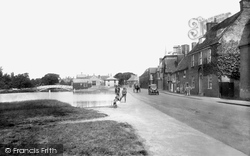
The jettied, gabled building (centre right) was renovated in the early 1950s and is home to the Riverside Fish and Chip Shop.
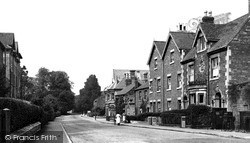
Looking west away from the town centre, with West Bank, a school boarding house on the left and opposite houses built around 1900 (a date on the nearest house is 1901).
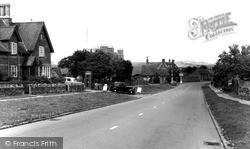
This photograph was taken about five years after R353020 (pages 62-63) and further down the hill towards the centre of Rockingham.
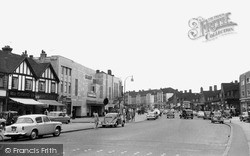
Kingsbury Underground Station is situated some distance to the north-west of the original village centre, and within a range of not unattractive shops, seen on the right, with their pitched dormered and
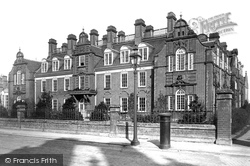
Newnham College was Cambridge's second college for women, and was built a lot closer to the centre than the first one at Girton.
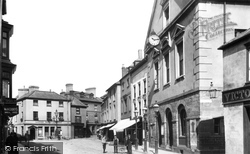
They have a charming differentiation – 'High Street Superior' and 'High Street Inferior' - but they are the same street, with the name change at the town centre crossroads.
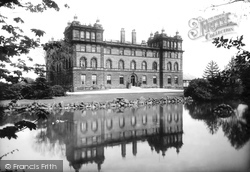
Guests were encouraged to walk up to the nearby White Wells and the Tarn, and because of this proximity to the Ilkley Moor, Wells House quickly established itself as a popular recuperation centre.
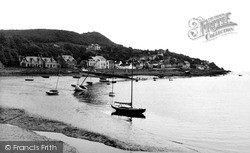
By the 1920s shipbuilding had declined, and in the years since Kippford has become a popular yachting centre, its harbour and channel busy with visiting boats in the summer months.
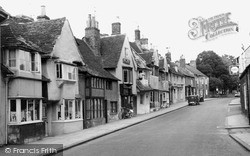
The house occupied by the courageous window-cleaner (centre) bears a 1716 datestone, and its neighbour (then, as now, housing the Royal Air Force Association) a datestone for 1663.
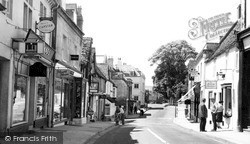
Kenelm's death made his grave second only to Thomas Becket's as a site of pilgrimage during the Middle Ages, and Winchcombe one of the region's earliest tourist centres.
He was passionately concerned for the fate of shipwrecked sailors, and gave them proper burials - in the centre is the white figure-head of the brig 'Caledonia' that broke up in 1842.
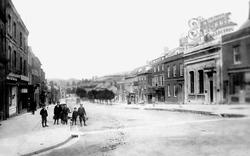
Colmer's Hill is the distinctive distant hilltop(centre).
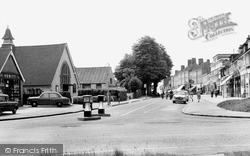
The large many-chimneyed neo-Georgian buildings on the right, Chiltern Parade, were built in 1936 by Sainsbury's who occupied the centre shop.
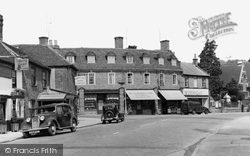
The old centre of Chalfont St Peter has suffered greatly, by-passed too closely and swamped by housing estates, the houses steadily increasing in size before merging with the affluent 'Metroland
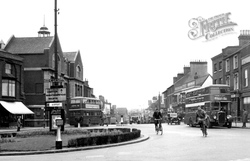
From market place to bus terminus, centre for further education and declining shopping area; by 1955 Park Square was ripe for the redevelopment that did not actually happen for another 25 years.
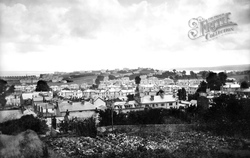
Beyond, in the centre of the picture, is the Totnes Road development of 1890, showing the movement away from detached villas to semi-detached houses.
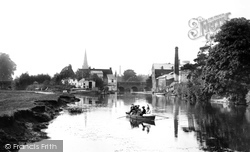
Nag's Head Island is in the centre with its hotel fronting the bridge, and Stevens's Boatyard are the white buildings to the left.
Places (57)
Photos (98)
Memories (1253)
Books (2)
Maps (316)