The Francis Frith Collection.
You are here:

The Cambridge Ghost

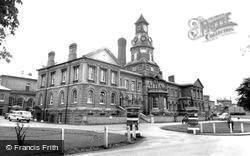
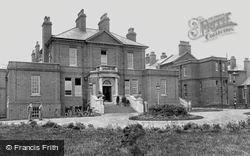
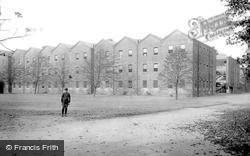
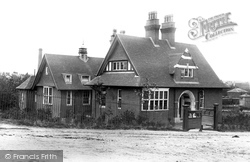
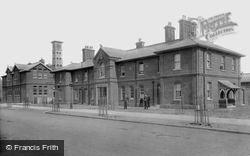
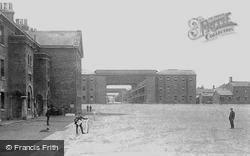
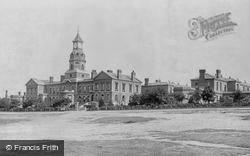
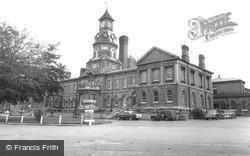
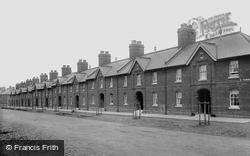
Cambridge Military Hospital 1891
Enlarge photo |  More about this photo

The Cambridge Military Hospital was apparently founded as part of the initiative begun by Florence Nightingale after the Crimean War to improve medical facilities for the Army. It was built on a grand, traditionally solid Victorian scale, and as I remember, had very long corridors, which seemed to be about a quarter of a mile long! At least, it seemed, standing at one end, the roof and floor met at the other.
In February 1969 as a cadet at the nearby Sandhurst, I had an accident on the assault course, twisting my knee badly on the frozen ground. The injury was quite severe and I was required to have an operation and physiotherapy as an in-patient, so I spent several months in Ward 7. At this time, Northern Ireland had only just started up and there weren't many major military campaigns underway around the world, and so the hospital was not full of military patients. It was the policy then to take in overflows from NHS hospitals and so there were a number of wards of civilians, including a ward for terminally ill patients and another for children. A young QARANC sister, Lt Collinson came to Ward 7, and as a long-term but 'walking wounded' patient, we became friendly and had a chat from time to time. On one occasion, having just finished a stint as the hospital duty night sister, she came and told me the following story (as I recall it):
The ward, consisting primarily of separate rooms and cubicles, for the very, seriously and terminally ill patients was on the ground floor and the children's ward was on the second. Sister Collinson doing her rounds, was visiting the children's ward in the early hours of the morning, when there appeared to be a sudden and dramatic drop in temperature, to the point where breath could be seen. It was a passing phenomenon, and although remarkable, might perhaps have been passed off as a cold March draught in an old hospital. Later, she toured the terminally ill ward and came to the bed of an elderly woman, who was still awake. Beside her bed stood an empty glass that seemed to have contained milk. Sister Collinson, noting this and knowing that milk wasn't available, asked the woman where it had come from. The woman told her that she'd woken, feeling thirsty, and had been approached by 'another sister' wearing the usual QA sister's uniform of grey/blue dress and bright red cape, who'd given her the milk. The sister hadn't spoken, and had quickly gone, but the woman noted that the sister's dress had been unnaturally long, almost down to her ankles. Sister Collinson thought that the woman, being so seriously ill had perhaps been a bit delirious, but checking with the nurses on the ward found that there had been no other sister around and that no-one had given the patient a drink. The woman died a few hours later.
Intrigued, Sister Collinson had asked around and was told of the hospital ghost, who had been quite regularly sighted, although usually at a distance. Apparently, the story went, a young QA sister had worked in the hospital during the First World War when the hospital had been full of wounded soldiers evacuated from the front in France. Following one of the offensives, the hospital had filled with wounded soldiers, many seriously, and the staff were under considerable pressure, tired, stressed and overworked. One day, a new intake of wounded soldiers arrived, one of whom was a young officer, the seriously wounded fiance of the sister, who, coincidentally was assigned to deal with him. On seeing her fiance, she had panicked and accidentally gave him an overdose of an anaesthetic or drug, from which he shortly afterwards died. Full of remorse, and depressed, the sister committed suicide. From that time on, she was occasionally encountered in the long corridors, mostly around that part of the hospital where her fiance had been admitted and had himself died.
Thinking back, Sister Collinson realised that the approximate time that the milk had been given to the dying woman, had been just the moment when she had been in the children's ward, which she also realised, was almost immediately above the terminally ill ward.
It is said that intense cold often accompanies spiritual visitations, but perhaps it had just been an unusual draft and a delirious old lady, but - perhaps it hadn't.

Anyway, that was my abiding memory of the old Cambridge hospital, when in the 'good old days' before NHS and MOD reorganisations, there had still been an adequate system to treat the Armed Forces.

Written by James Ritchie. To send James Ritchie a private message, click here.

A memory of Aldershot in Hampshire shared on Friday, 23rd November 2007.

Memories Links

Other memories of Cambridge Military Hospital 1891

See more memories of Aldershot

Aldershot homepage

Add a Memory for another place

Tips & Ideas

How has this scene changed?

Do you know who lived or worked here?

Why is this photo significant to you?

Particular points of interest - transport, architecture, fashions etc.

Comments

RE: RE: The Cambridge Ghost

I spent 3 years at the Cambridge 72-75 and heard many stories about ghosts. Another ghost apparently haunted the clock tower. Yes the corridor was about 1/4 of a mile long. When I was posted there, the childrens ward was downstairs known as Ward 1. The hospital served the local community as well as the military. The story about the male other ranks accomodation was condemed before the war, during the war the Paras moved in, and straight out, so the medics were moved in......

Anyway, there was an unusual, if rather special atmosphere about the place. I believe it's now a listed building, if not it should be!

Mixed fellings and memories.....

Comment from Terry Bassett on Monday, 20th September 2010.

RE: RE: The Cambridge Ghost

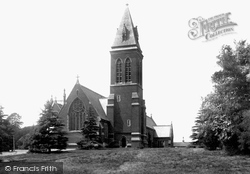
I was in the choir of the Royal Garrison Church 1963-68. We used to go and sing carols every Christmas Eve, first in the Louise Margaret maternity hospital then in the Cambridge. We robed in the Red Cross room, processed the entire length of that huge corridor, turned back at the end then visited each ward in turn, up stairs and down. Finally it was back to the Red Cross room for coffee and mince pies. I was born in the Louise Margaret, as were both my children. My son, while growing up, was forever injuring himself and we were always grateful for the care given to him in A&E at the Cambridge.

Comment from Fiona Birchall on Wednesday, 13th April 2011.

Comments

2 comments have been shared so far in response to the memory "The Cambridge Ghost".

Why not get involved and post your comments using the comment form below.

Post a Comment about this Memory

To post a comment about this Memory, complete the form below. Your comment will appear alongside the original Memory on the website. If you wish to send a private message (not published on the website) to the person that wrote the Memory, click here.

Subject: RE: The Cambridge Ghost
You have to be logged in to be able to post a comment.
If you have a Frith account, then please log in below, if not, click here to create one.
Email:
Password:
Comment:
  Note: There is a 300-word limit - you have 300 words remaining.

© Copyright 1998-2012 Frith Content Inc. All rights reserved.