Places
8 places found.
Those places high-lighted have photos. All locations may have maps, books and memories.
Photos
77 photos found. Showing results 361 to 77.
Maps
49 maps found.
Books
Sorry, no books were found that related to your search.
Memories
1,425 memories found. Showing results 181 to 190.
St Marys Home
My memories of the home, which was run by the Southwark Catholic Rescue Society. The sisters of charity looked after us, I was taken there just before my 10th birthday in april 1947 along with brothers Bill 13 and Bob 4. My early ...Read more
A memory of Gravesend in 1947 by
St George's Sunday School?
I am wondering if anyone can tell me the following; I am trying to find out what year the Prestyberian ittle school was built. I know it was up nearer the old original Black Lion, but can anyone give me a date as to when it was built, or a picture, many thanks.
A memory of Little Sutton by
Bomb Blast `siding` Margaret Street/Victoria Street.
I recall as a young boy of 7 or 8, that I was among a group of friends playing on the siding at the bottom of Margaret Street. We, as friends, found the bomb on the Rhigos Mountain and carried ...Read more
A memory of Treherbert in 1943 by
Born On Sutton Flats
I was born on Sutton Flats (now demolished) Pendleton in 1941. My first vague memory was sitting under a table with a blanket draped over it and a lit candle (must have been an air-raid on at the time). My first real memory ...Read more
A memory of Salford by
Those Were The Days
I was born in the home of my grandparents John and May (nee Hulse) Yeomans in Mere Road, my mother being the former Kathleen Yeomans. My immediate neighbours on either side were Jack and May Platt and ...Read more
A memory of Weston in 1940 by
The Ghost
My dad, even though married he was one for playing the field. Mother was taking care of my brother's kids (his wife had died, he was a Flight Sargent), Mother was miles away and Dad played about. One afternoon he had picked up ...Read more
A memory of Royston by
Up The Overs
Walking free through the wet grass leaving dark trails. Ahead the meadow rises to the mill bank where we stand in silence. Silent and smooth the deep mill race slides towards the wheel. Turning away we follow the bank upstream to ...Read more
A memory of Kempston in 1950 by
Doddlebugs And V2s Plus!
I moved to Lymington Road, Dagenham, in 1939, across the road from the school. At first I attended Green Lane School - same as Dudley Moor. I even had the same piano teacher. Miss Hoggard. But she gave up on me. In the ...Read more
A memory of Dagenham by
Floods Of '53
Was 7, lived at 'Ocean View' opposite Ostend Road, the sea never reached our house. I remember seeing the total devastation the following day. My adopted mother, Doris Bean, worked at the Stores for Chippy and Bill Murphy, and after ...Read more
A memory of Walcott by
Good Old Stan
I was to live in Blackpool for a short while and would work on a farm; I lived with my sister and brother in law in Delphine Avenue. Lawrence my brother in law leant me his Honda fifty motorbike, I pulled into a petrol station ...Read more
A memory of Blackpool in 1970 by
Captions
876 captions found. Showing results 433 to 456.
This is Nutcrack Lane at Ridge, between Stoborough and Arne, where Roman pottery kilns and Victorian industry were followed by 1930s homesteading.

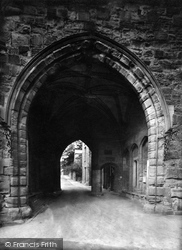
However, following a reappraisal of the college's status, the college ceased training people for the priesthood in 1971.
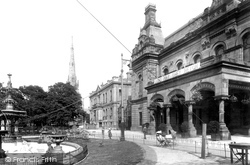
The sign above the entrance of Cambridge Hall indicates that the picture was taken around 1901-02 following the accession of King Edward VII.
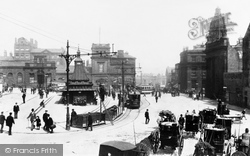
In September 1906 the tramway announced record takings for the year of £70,295 and the following year the record was broken again with takings of £73,514.
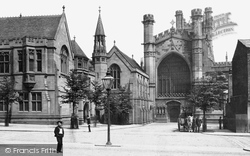
Following its dissolution during the reign of Henry VIII, the former abbey was granted cathedral status.
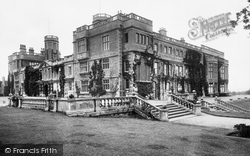
Its avenues were planted following a visit by William III. The house was started by the 1st Lord Compton, later the Earl of Northampton, in 1574.
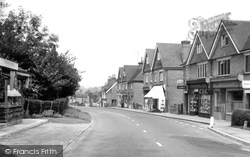
Until 1925 the settlement was known as Horeham Road, but following a ballot of the villagers the name was changed to Horam.
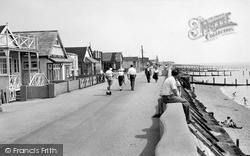
This became a popular holiday area after Jaywick Farm was sold following the farming recession of the 1930s. The land was sold in small plots, and the area became a bungalow township.
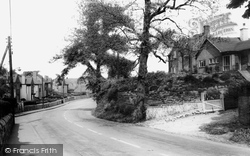
After the Norman Conquest, the lands belonging to those theyns who had either fought for Harold or were implicated in the Northern rebellions were confiscated and awarded to William's followers.
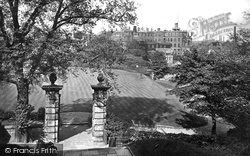
Following the clo- sure of the hospital in 1992, the main building and the Round Tower of the Jubilee Wing were taken over by Nottingham Health Authority.
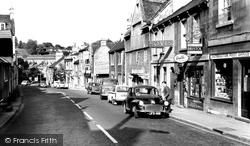
This follows the course of a much older road, the Roman 'Fosse Way', which runs from the 'colonia' of Lincoln to Axminster in Devon, built as a military road around 47 AD.
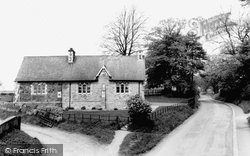
Hutton was really put on the map by the coming of the York to Scarborough railway, which follows the valley of the River Derwent to the sea.
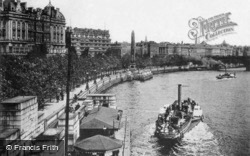
, this view looks along the Embankment from Charing Cross Bridge to Cleopatra's Needle, an Egyptian obelisk of 1500 BC, given to Britain in 1819 by the Viceroy of Egypt, but only erected here in 1878 following
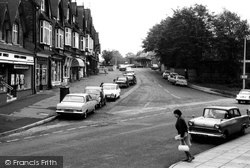
In return for granting permission to the GWR to build the line across his land, local landowner George Frederick Muntz demanded the provision of a station: houses and shops inevitably followed
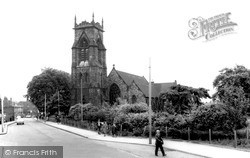
He used to preach with the church door open so as not to miss fellow cock fighters passing by on their way to matches at Darlaston Fields - and would cut short his sermon to follow them.
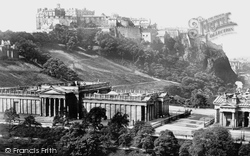
The Edinburgh Castle we see today is, with a few additions, that built by the Earl of Morton following the siege of 1572.
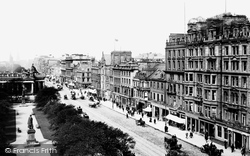
Next on the list were the Caledonian, the Station and the Royal, followed by the somewhat cheaper Royal British, the Douglas and the Bedford.
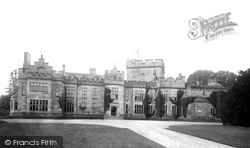
Salvin returned to Greystoke in 1868 to carry out restoration work following a fire.
He used to preach with the church door open so as not to miss fellow cock fighters passing by on their way to matches at Darlaston Fields - and would cut short his sermon to follow them.
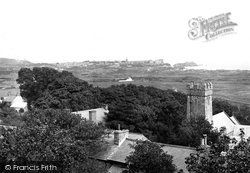
The tree line follows the line of the Tenby Pembroke railway track.
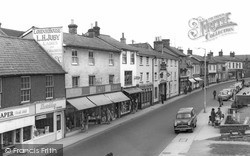
On the right is the forecourt of the Congregational Church, which was rebuilt in 1955 following its destruction by a German bomb in 1940.
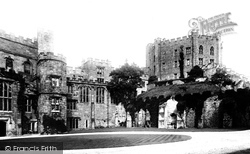
A university was officially established at Durham in 1657 during the Commonwealth, but it was suppressed following the Restoration. Durham was finally granted its university in 1832.
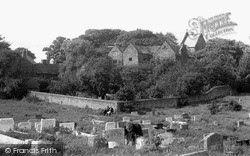
The hall was greatly altered in the 17th century, and in 1955, following its restoration, it was officially opened by the US ambassador. It is now in the care of the National Trust.
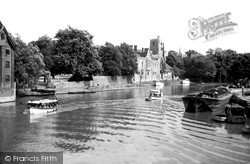
Originally built by Archbishop Islip in the mid 14th century, it was subsequently altered by Archbishop Morton during the following century.
Places (8)
Photos (77)
Memories (1425)
Books (0)
Maps (49)