Merry Christmas & Happy New Year!
Christmas Deliveries: If you placed an order on or before midday on Friday 19th December for Christmas delivery it was despatched before the Royal Mail or Parcel Force deadline and therefore should be received in time for Christmas. Orders placed after midday on Friday 19th December will be delivered in the New Year.
Please Note: Our offices and factory are now closed until Monday 5th January when we will be pleased to deal with any queries that have arisen during the holiday period.
During the holiday our Gift Cards may still be ordered for any last minute orders and will be sent automatically by email direct to your recipient - see here: Gift Cards
Places
4 places found.
Those places high-lighted have photos. All locations may have maps, books and memories.
Photos
68 photos found. Showing results 181 to 68.
Maps
70 maps found.
Books
Sorry, no books were found that related to your search.
Memories
713 memories found. Showing results 91 to 100.
Some Childhood Years In Sorbie 1932 T0 1937
The family moved from Reay in Caithness to Sorbie in 1932 - I was 2 years old and had a sister who was 12 years old and a brother, 10 years old, so there was a huge difference in ages and I was brought up as ...Read more
A memory of Sorbie in 1930 by
Metal Bridge My Grandfather Harry Holmes My Childhood
Harry was born at spennymoor 1877, he moved to metal bridge in 1898 when he married Elizabeth Joyce born 1878 from Easthowle.They were married at St Lukes church, Ferryhill by vicar Lomax, ...Read more
A memory of Metal Bridge by
My Gran & Grandad Jack Spencer
Jack & Unice Spencer were my grandparents, they owned the boats on Pickmere Lake. My life after the war was idillic when living with them, thousands flocked from Salford & Manchester to camp, fish and row my ...Read more
A memory of Pickmere in 1953 by
I Lived In 1 Rockcliffe View Carlin How
I lived in 1 Rockcliffe View Carlin How, from about 1946 to 1952, then my father retired and we then moved to Loftus. My father was Jim Conway the Police Constable. I went to Skinningrove Senior School, was ...Read more
A memory of Carlin How in 1946 by
Bury Road
I well recall helping to pull the 40th Epping Forest Scouts trek cart with its iron shod wheels loaded with camping gear, along here on the way to Gilwell Park.
A memory of Chingford by
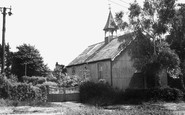
St Mark's Church, Magham Down
The church was a mission hall, part of Hailsham Parish. It was constructed of green painted corrugated iron. There was just one large room, with a curtained vestry at the rear. There were two services a month, a ...Read more
A memory of Magham Down in 1954 by
Up The Overs
Walking free through the wet grass leaving dark trails. Ahead the meadow rises to the mill bank where we stand in silence. Silent and smooth the deep mill race slides towards the wheel. Turning away we follow the bank upstream to the ...Read more
A memory of Kempston in 1950 by
Abbotts Hall Chase Army Huts From 1946 1948
I was four years old when our family moved from Liverpool to squat in one of the army huts. I remember it very well, and the German prisoners of war who made such a fuss of us children. We had no ...Read more
A memory of Stanford-le-Hope in 1946 by
My Young Life Living In Eve Road, West Ham
I can remember my infant years at Napier Road school. I remember when I was in the first year there, we would have a small slice of toasted bread in the afternoons. Then I went to Holbrook School when I ...Read more
A memory of West Ham in 1958 by
The Warren.
I remember when I was nursing at Ashford, Hothfield and Willesborough hospitals. We use to have to go to the Warren for some lessons. I can still remember my shock at seeing rows of `Iron Lungs` that were no longer in use. Also seeing the ...Read more
A memory of Ashford in 1968
Captions
788 captions found. Showing results 217 to 240.

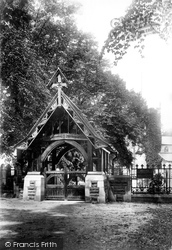
You can see the iron railings around his grave at the bottom left of our picture. The church is built in Perpendicular style.
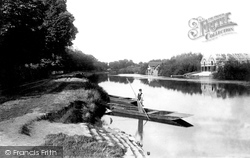
On the Wraysbury bank, near to where we see the boathouse of W Hanes and Sons, there once was a wharf where iron ore was landed for refining at a local mill before being taken to London.
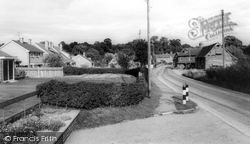
In 1140 the Norman Lord of the Manor, Geoffrey of Limesey, built a church (probably on the site of a Saxon one) dedicated to St Leonard, patron saint of prisoners and, appropriately enough, of iron workers
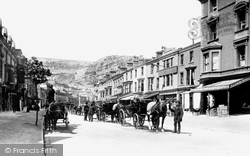
Mostyn Street is one of Llandudno's main shopping streets; we see it here pictured in bright sunlight.
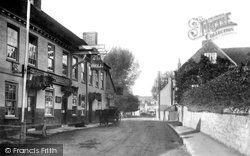
Four hundred years ago, Godstone was at the centre of the leather trade and the manufacture of gunpowder, while to the south there were important iron-works.
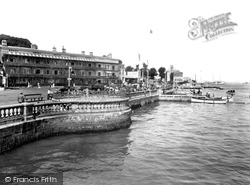
The ornate circular iron railings attached to the balustrade were replaced by a set of public toilets that stood on the Parade, but were removed after the Second World War.
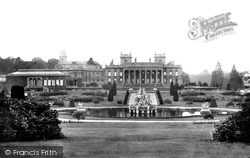
The land around once belonged to the Cookesey family, but was bought in the 1600s by Thomas Foley, who had made his fortune in the iron trade.
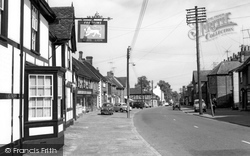
Earls Colne is a large industrial village on the A604: silk-winding, brick-making, seed-growing, and iron-founding have all taken place here.
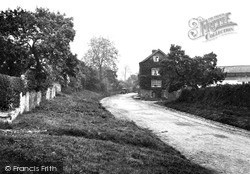
Lying at the end of a little lane that is a dead end, this is yet another former port that now lies, quite literally, some miles inland - the church even has an iron ring attached to it where once, so
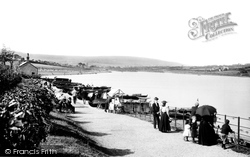
Ignoring the small building (left) and the iron railings this could almost be a rural scene.
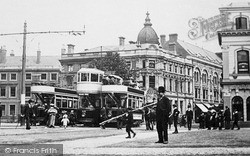
Though famous for its leather goods,Walsall grew up on coal and ironstone mining, iron working, and limestone quarrying.
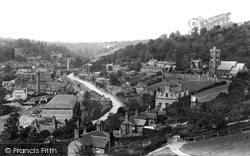
Abraham Darby bought a furnace in 1706 and began experimenting with ways of smelting iron by using coke rather than charcoal In 1709 he mastered the technique and changed the world.
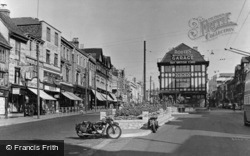
Numbers 93, 94 and 95 High Street, on the Bank Street side, date from about 1855, an early example of an iron-framed building.
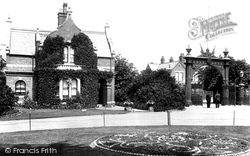
The typical wrought-iron gates, like so many others, met their fate in 1940 when they were smelted down for the war effort.
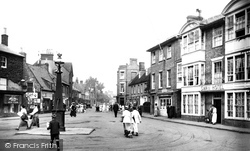
The centre of the Market Place is marked by a splendid Victorian cast iron water pump, decorated with fish, crown and arrows, and the motto 'Defend They Ryghts'.
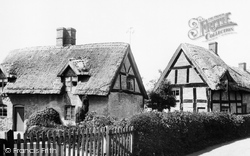
At the time of the Industrial Revolution the people of Lilleshall, until then mainly a farming community, began mining limestone to supply the iron-smelting industry at Coalbrookdale.
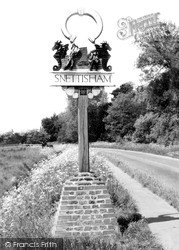
A fabulous collection of more than a hundred gold, silver and electrum torcs, dating from the Iron Age, was found here: they are now in Norwich Castle Museum.
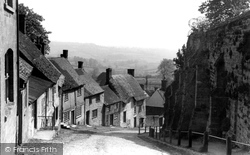
The hilltop town of Shaftesbury began its existence during the Iron Age, but it became important when King Alfred founded an abbey here and installed his daughter as abbess.
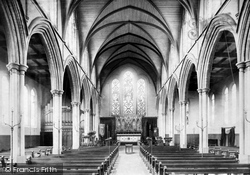
The Early English-style interior has arcade columns of cast iron and a continous roof in timber-ribbed vaulting.
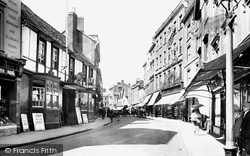
An auction notice on the left of the picture advertises a sale of five hundred sheets of corrugated iron and imported timber.
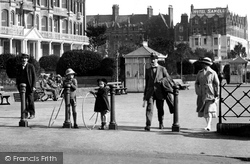
The four iron bollards replaced the earlier turnstile which charged a small entry fee to the gardens.
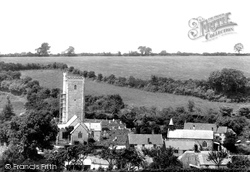
The hillsides and vales of Membury have been farmed since at least the Iron Age.
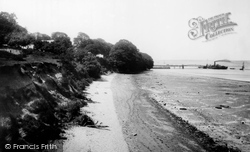
The iron pier was built in 1874 by the lessees of the Eastham Ferry Hotel, obviously with an eye to improving their own trade as well as that of the village.
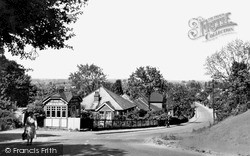
The High Road itself, ironically, tended to be where the better-quality homes were built.
Places (4)
Photos (68)
Memories (713)
Books (0)
Maps (70)